


About HistoVeaR
Wearable History
How we bring historical clothing to life in virtual reality.
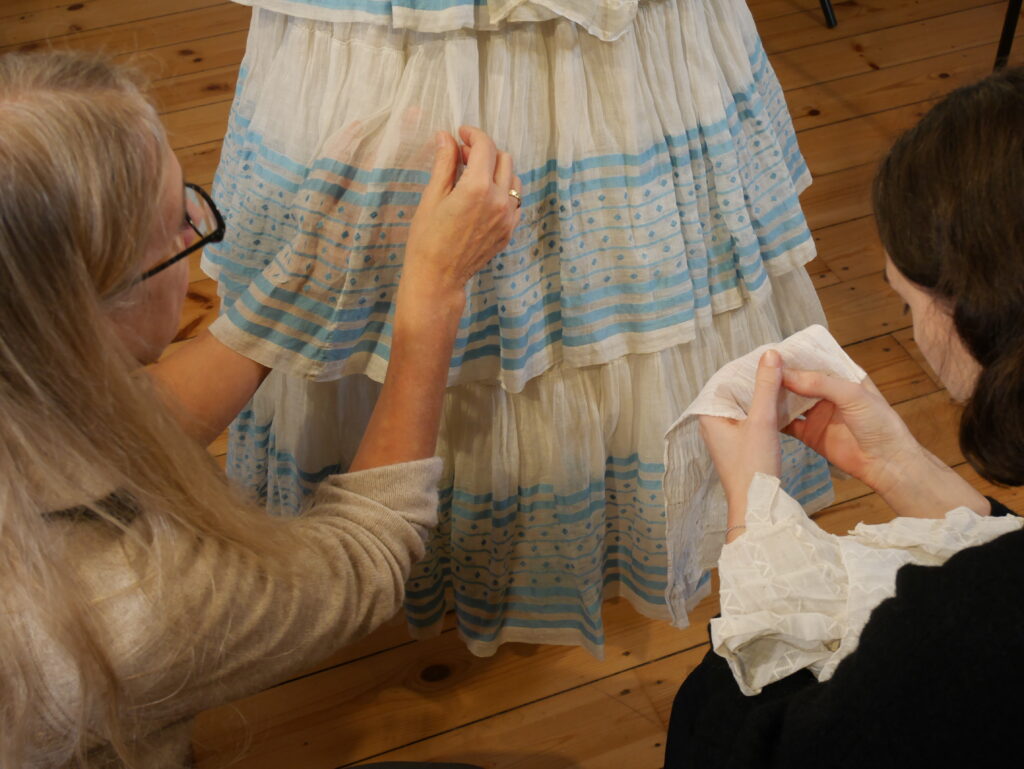
Clothing is a mirror of its time. It is fast-changing, diverse, and reveals an incredible amount about how people once lived. That’s why historical garments are true treasures – windows into another world. But there’s a problem: over the years, oxygen, light, and microbes break down old fabrics. To prevent this, these treasures are carefully protected in museums and collections. Visitors, however, can hardly imagine what this clothing once looked like when worn or in motion.
Most preserved garments are extremely sensitive. They need to be stored under special conditions and can under no circumstances be worn. While understandable, an important aspect is lost: the feeling. What does the fabric feel like? How does it flow? How does one move while wearing it? Everything that makes clothing special – the interaction with the human body – gets lost.
Our project, HistoVeaR, targets exactly this issue.
We’re taking these garments out of the display cases and storage boxes of museum archives – digitally. Our goal is to reconstruct historical clothing in 3D based on real historical garments and their material properties, animate them, and bring them to life in virtual reality (VR).
What is a "Digital Twin"?
We are not simply creating a 3D Model, but rather a "digital twin". This means that we take everything that makes up the garment – the pattern, the kind of fabric and its physical properties (stiffness, weight, elasticity) – and rebuild it digitally.
What makes this special is that the digital twin will react to users’ movements in real time. When you lift an arm in VR, the sleeve – whether made of silk or heavy velvet – should drape and fold just as authentically as the original.
And the best part: we want this process to be simple. Our goal is to create a toolset that anyone can use without days of manual work – something that allows researchers, museums, and creatives to bring their objects to life with ease.
Problem Statement & Objectives
Folds are Unpredictable – Why Digital Clothing is so Technically Tricky
Why do (historical) garments in many games and films often look stiff or "wrong"? The short answer: because clothing is extremely complex. And that’s exactly the challenge we’re taking on.
The complex behavior of fabrics is an algorithmic nightmare. The way a fabric drapes, which folds are created and how it reacts to light all depend on many factors. Until now, the easiest solution has been to simplify everything. However, when clothing is not represented authentically – while it may save processing power – it can distort our understanding of history.
Our core goal is to create a digital clothing workflow that is realistic and works in real-time. To achieve this, we need to overcome four large obstacles:
1. The Digitalization: How can we transfer the precise cut and, more importantly, the “mechanics” of a fabric to a computer? How can we scan a garment so that every layer, fold, and added element is translated into bits and bytes? On top of that, we need to measure its physical properties – how stretchy, stiff, or heavy the material is. The biggest challenge: all of this has to happen without damaging the fragile garments in museums. Standard testing methods, where fabric strips are partially scanned, clamped, or even torn, are completely out of the question.
2. The Visuals: To make the clothing look truly authentic, we need to capture its appearance with great precision. That’s often extremely tricky when dealing with historical fabrics. Think of highly glossy silk, deep velvet that absorbs light, translucent veils, or the complex interplay of multiple layers of material. Visualizing all of this realistically pushes today’s hard- and software to their limits.
3. The Real-Time Simulation: It’s no use if the simulation looks great but takes a full minute to calculate. In virtual reality, everything has to happen instantly. The fabric must deform fluidly and in a physically accurate way, while the system continuously tracks where the user’s body (the avatar) is. The clothing can’t pass through the body, and at the same time, multiple layers of garments (think: petticoats) need to interact to produce the correct draping and folds.
4. The User Experience: In the end, even the best technology is useless if the experience doesn’t feel real. The challenge is to make the interaction intuitive. What does it feel like to “wear” the digital fabric? How do we convey the sense of weight or restriction that historical clothing often involved? The goal is to build a bridge from pure technology to a tangible experience – one that allows users to truly immerse themselves in the past.
Target Audiences
From Museum to Blockbuster – Who Benefits from HistoVeaR?
So, we’re developing a complex system to bring historical clothing to life digitally. But who actually needs this? The answer: surprisingly many people! Our project focuses on three main areas, and we’re sure there will be more to come (for example, the fashion industry)
1. Museums: Experiencing History
Simplifying digitization: Creating AI-supported “digital twins” makes the digitization process much easier and faster.
Improving archives: Over time, this will create a vast digital collection that is invaluable for research.
Reimagining education and outreach: The most important aspect is the experience itself. Visitors will no longer just look at historical clothing – they’ll be able to experience it in VR. It’s a completely new way to make history tangible.
2. Film: More Authentic Worlds
The film industry also benefits greatly, both in the pre-production stage as well as in the final visual effects (VFX).
Realism: Directors and designers can see what a costume looks like in motion early on.
Simplified workflows: Realistic cloth simulation becomes significantly easier.
Authenticity: Historical films gain visual quality when clothing finally behaves the way it’s supposed to.
3. Digital Games: More Realism, Less Work
Historical settings are very popular in games, although difficult to pull off.
Enormous time savings: Until now, creating realistic clothing in 3D programs has been incredibly labor-intensive. With our toolset, this effort is drastically reduced, making it possible to increase both the variety of garments and the level of realism in games.
Perfect for game engines: Our focus on real-time is exactly what is needed for games. The created models are also directly compatible with common game engines like Unity and Unreal.
Better immersion: When a game character’s clothing reacts realistically to the player, wind, or movement, players become much more deeply immersed in the world.