



Among other things, the textile collection of the LVR Industrial Museum is stored in the Peter Behrens Building in Oberhausen. The collection focuses on everyday clothing intended to represent all social classes as well as the clothing-specific characteristics of the respective eras.1 As part of the interdisciplinary project HistoVeaR, historical garments from the collection are being researched, physically and digitally reconstructed, and virtually animated. So far, a Robe à la française from the late 18th century and an evening dress from the mid-19th century have been selected. Both women’s garments consist of several components and only achieve their characteristic silhouette when combined with the appropriate undergarments and support structures, such as corsets, hip pads, hoop skirts, or crinolines.
Only occasionally do complete clothing ensembles make their way into museums. Possible reasons for the incomplete preservation include, for example, the shame of the original wearers or the aesthetic perceptions and value judgments of collectors. In exhibition contexts, both the missing bodies and the supporting understructures are replaced by custom-made mannequins and supports. This allows visitors to experience the three-dimensional effect of the historical garments. At the same time, the mannequin and support structure stabilize the fragile exhibits during the exhibition period and thus meet conservation requirements.2 For the research project, it is necessary to reconstruct the clothing ensembles as completely as possible.
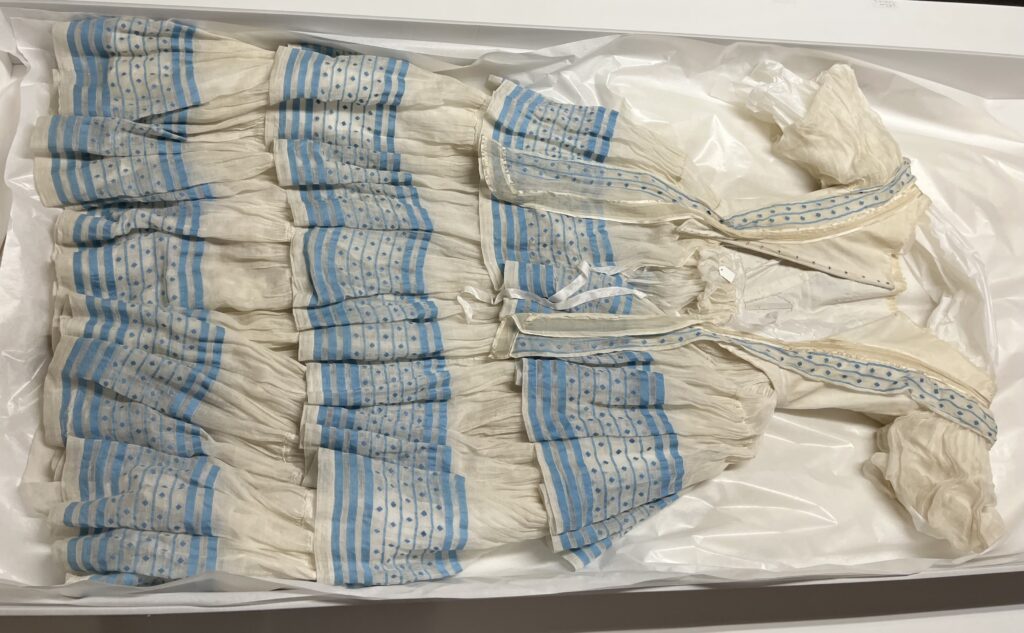


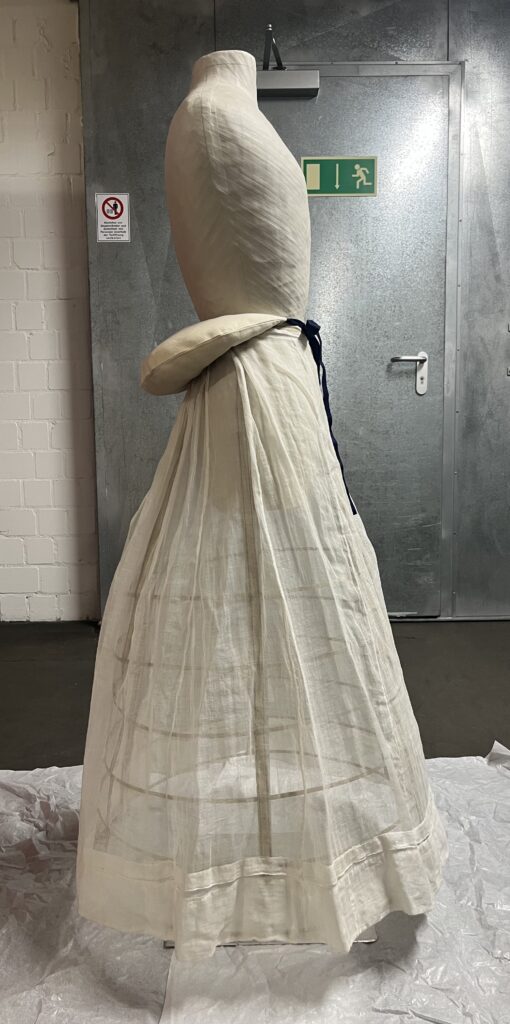
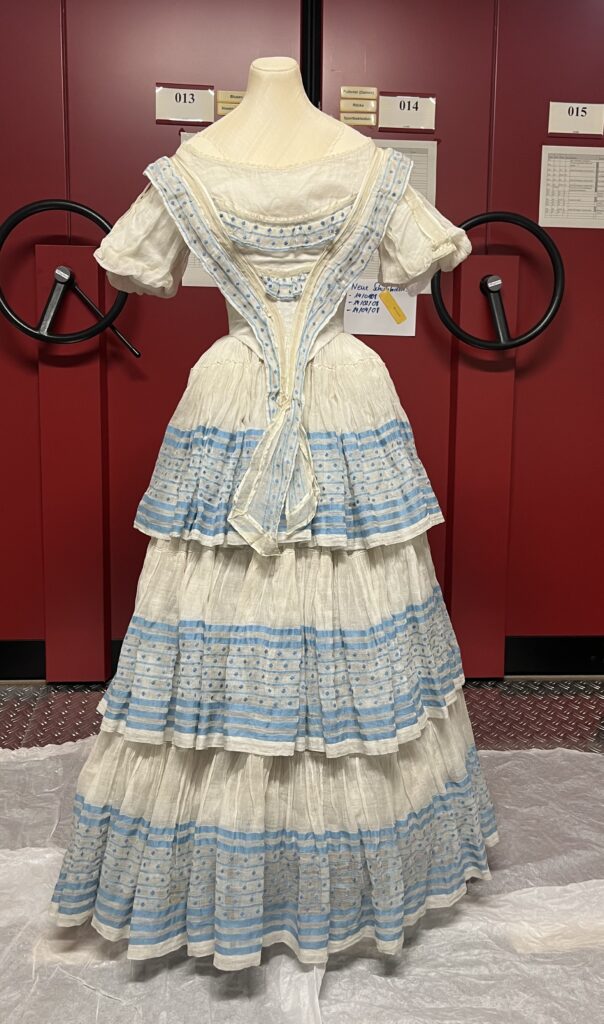
The evening dress made of cream-colored cotton with woven blue accents is one of the few objects in the collection for which not only the dress itself but also a petticoat and a steel-hooped crinoline have survived. Nevertheless, the preserved components also raise questions: Was the ensemble originally worn in this combination, or were elements added later? And which components may be missing? Comparisons between the examined evening dress and paintings, fashion engravings, or comparable garments from around 1850 reveal design similarities, such as the pointed waist and the tiered skirt. Differences can be seen in the skirt volume, which appears much wider at the hips in the comparison objects. One possible explanation could be both the idealized nature of visual media and the then-common practice of wearing hip pads. Accordingly, different hip pads were reconstructed and tested in combination with the dress.


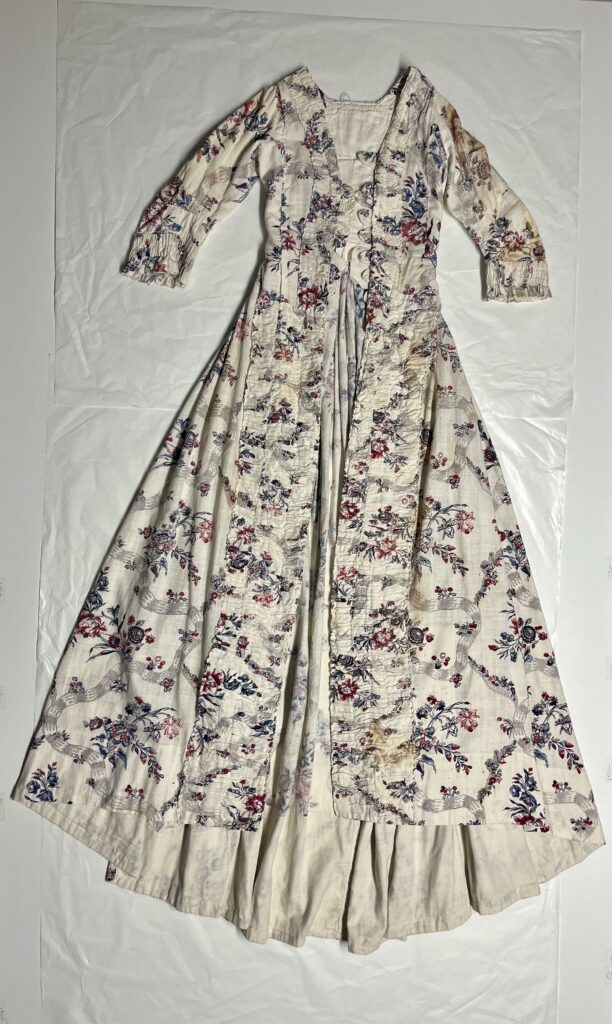
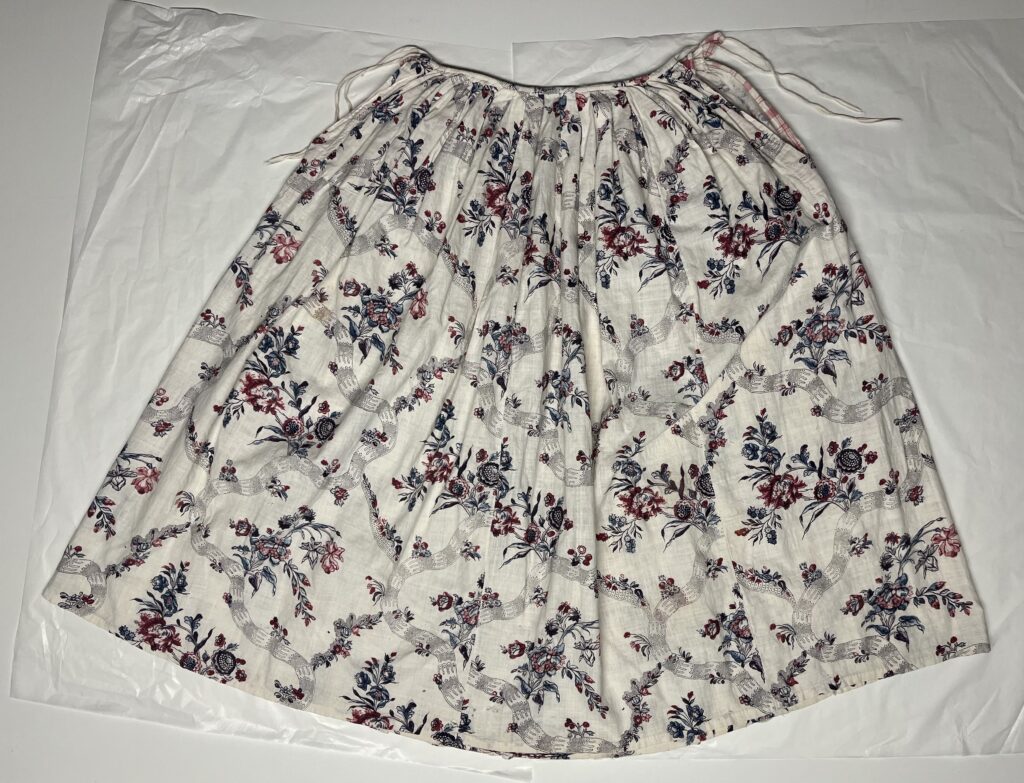


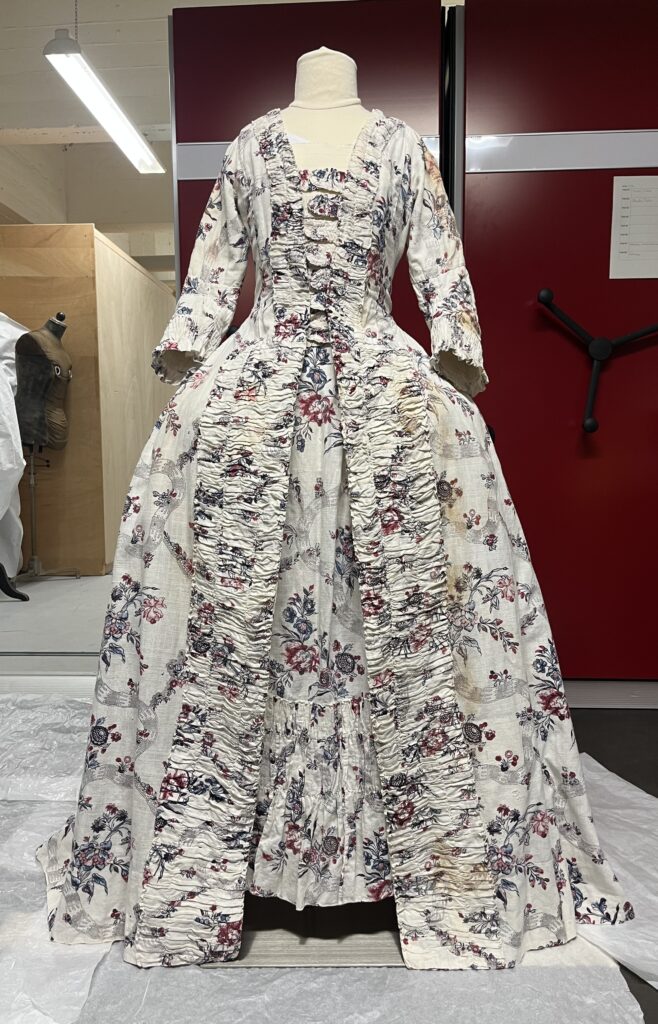
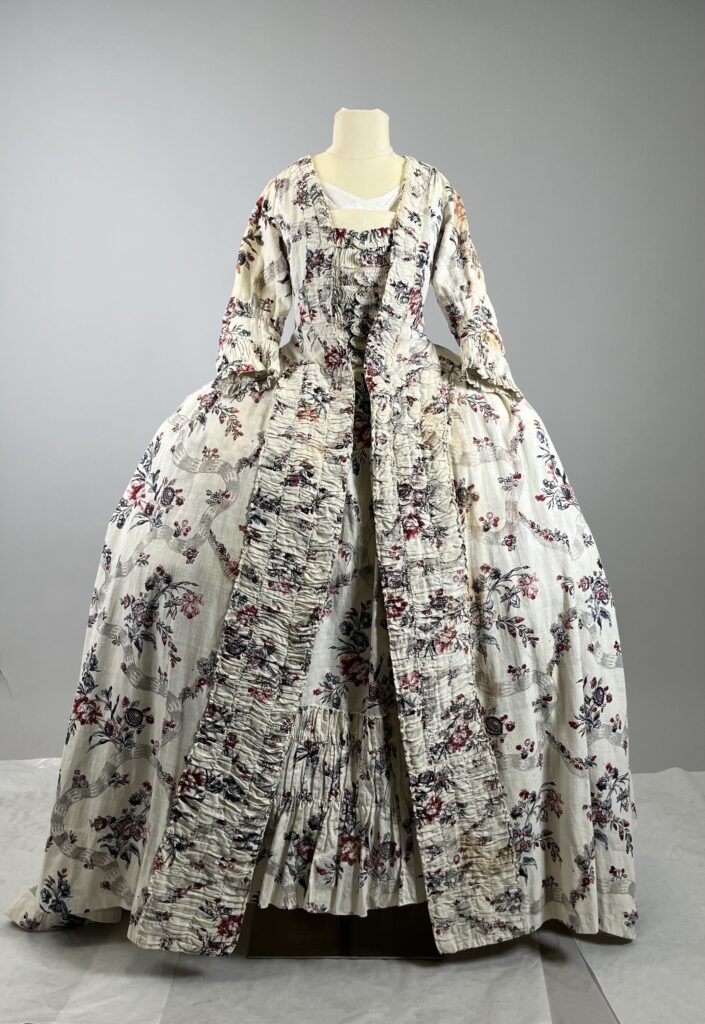
The oldest garment in the collection of the LVR Industrial Museum is a Robe à la françaiseconsisting of a Manteau à dos flottant (a gown with pleated fabric falling from the back) and a Jupe (skirt).3 It was made from a white cotton fabric printed with a large-scale floral pattern and partially hand-colored. A hoop skirt gives the dress its typical shape, with lateral volume at the hips and flattened front and back sections. Only in combination with the hoop skirt did the patterned fabric and fullness of the material achieve their intended effect.
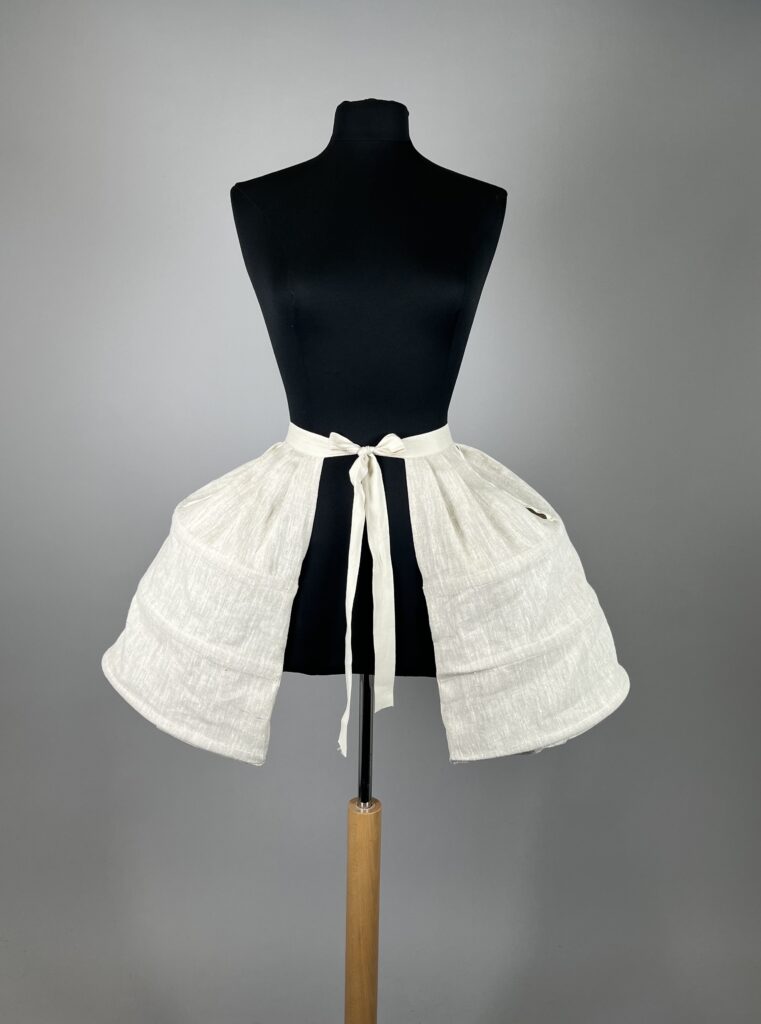
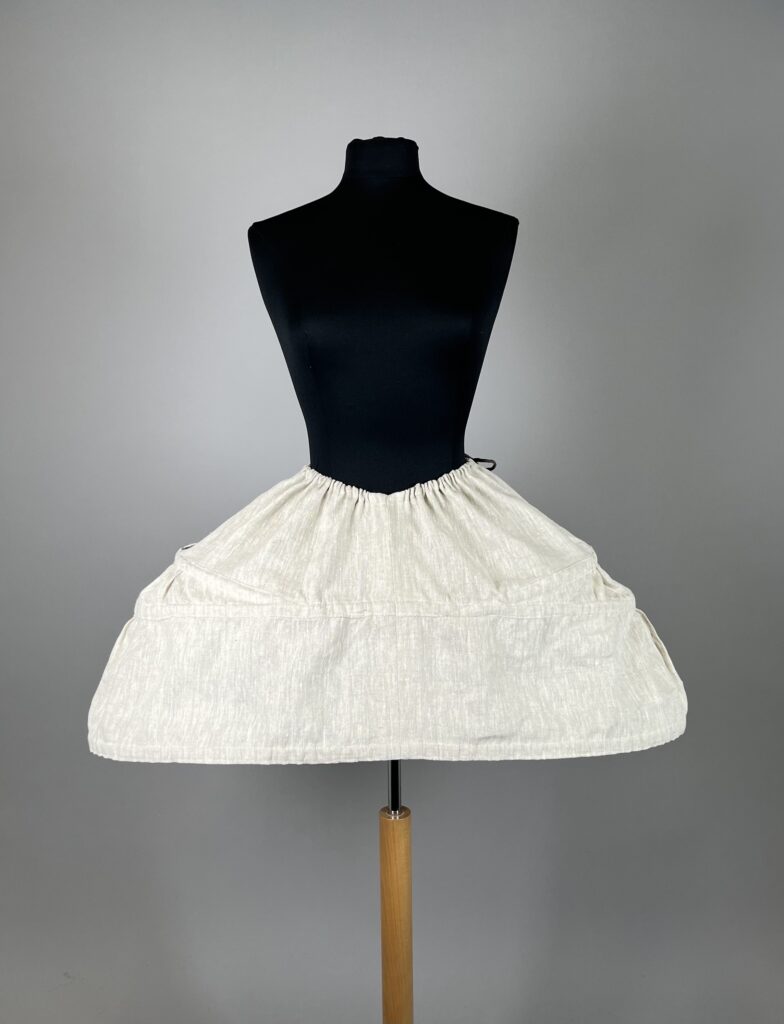
Since neither undergarments nor support structures from the 18th-century ensemble have survived, a historical underdress and a two-part Poche (pocket) were reconstructed. Demi-panier, reconstructed–panier (half hoop skirt) made of linen and metal was produced. In an effort to approximate the historical silhouette, this was further modified in order to achieve the most coherent overall appearance possible.
1 Cf. Caroline Lerch: Historical Clothing in the Museum: Of Bodies and Garments, October 26, 2021. https://zinkfabrikaltenberg.blog/2021/10/26/historische-kleidung-im-museum-von-korpern-und-kleidern/ [Accessed: 27 May 2026]
2 Cf. Laurence Becker: “Out of Static Display – Into Movement. Presentations of Historical Clothing in Different Poses.” In: Clothing in Motion. Women’s Fashion Since 1850 (Exhibition Catalogue, Historical Museum Frankfurt), Petersberg, 2020, p. 46.
3 Cf. Ingrid Loschek: Reclam’s Fashion and Costume Lexicon. Stuttgart, 6th revised edition, 2011, p. 425.
Leave a Reply